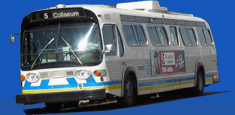
A General
Overview of the Situation
The administration of
Edmonton Transit brought up the idea of removing the trolley bus
system as a cost saving measure. Despite the many benefits
of trolleybuses, administration persisted with the idea of tearing
down a $73 million investment and did not once change their mind
about it.
Trolleys are Neglected
Anyone who has spent time observing the Edmonton Transit System
would be able to tell you that the trolleys are downright
neglected. No major work has been put into the buses - not
even a new coat of paint or power steering. Most bus
operators would prefer a brand new low floor with power steering
over a 22 year old trolleybus with no power steering. During
the council meeting, a member of the administration stated
something along the lines of "If $14 million is putting nothing
into the trolleys, then I don't know what is." The $14
million was strictly used within the electrical system, including
the overhead wires and substations. No portion of that money
went towards retrofitting the trolleybuses with any new features.
That same $14 million was not a huge portion of the ETS budget.
Two of the complaints mostly
used against Edmonton's trolleybuses are that 1. they are
not wheelchair accessible, and 2. they are unreliable.
The answers to these complaints are quite simple:
1. The buses are not
wheelchair accessible because they are from 1982. Low floor
buses were not being produced at that time, and management has not
retrofitted wheelchair lifts into those buses. It is
entirely possible to retrofit these buses, as Dayton, Ohio has
done it with the two trolleybuses they purchased from Edmonton
Transit.
2. Lack of maintenance to the trolley buses is evident, and
this is why reliability appears to be a problem. One cannot
expect a 22 year old trolley to run flawlessly, especially when
management does nothing to improve the condition of the buses.
Even the newest buses have problems. Another point is that
Edmonton has the only transit system in the world that keeps a
diesel backup for each trolley in service. The money used to
maintain these backups could easily be used elsewhere. If
construction is an issue, auxiliary power units (APUs) could be
installed on the existing fleet. However, Council decided
against this action.
Management seems to be
deliberately making the trolleys look bad so the public will want
to get rid of them.
Benefits of Trolleys
Trolleybuses are clean, quiet, and economical. No diesel bus
will ever come close to the attractiveness of a trolley bus, even
with the stricter emission regulations. Cities around the
world are starting or are continuing the use of trolleybuses due
to their great benefits. If they were such a lousy method of
transportation, the 300+ cities using trolleybuses would start
decommissioning them immediately. While the initial cost may
be greater ($900 000 for a trolley, $400 000 for a diesel), most
people believe our quality of life is much more important.
No street level emissions are
released with a trolley bus, and they run much quieter than a
diesel bus. As a matter of fact, every engine that ETS has
(except for the latest Cummins ISL engines in the 2004 model
buses) do not meet today's emissions standards. Also, it has
been stated that the Cummins ISC engines used in the 1998-2003 low
floor buses violates the city's noise bylaw!
Increasing the use of diesel
buses increases costs, as more fuel must be purchased/delivered.
While the maintenance costs may decrease, the continually rising
cost of fuel offsets this. Trolleybuses can be run on the
same electrical system, so each individual bus does not need to be
fuelled every night before being parked in the garage. In
other words, trolleys "share" the fuel on the run.
Air pollution is one of the
major disadvantages of running a diesel bus fleet. Trolleys
release zero street emissions, while diesels emit poisonous gases
such has nitrous oxide and sulfur oxide. Most people would
rather breathe clean air over a big black cloud of smoke.
New technologies such as diesel particulate filters are promoted
as a way to lower emissions, but they actually make the particles
smaller, which become more dangerous to your health.
Diesels can be considered
more versatile, as they can travel 100% without overhead power.
However, trolleys are good for the patrons who would rather ride a
constant route, not a route that has more stops before arriving to
the final destination. As mentioned before, APUs can be
added to trolleybuses so they can travel around unforeseen
obstructions.
The
Consultant's Report
A consultant from the
United States (Booz Allen Hamilton) was hired to compile a report
on trolleybus operations. Not only did the report cost
taxpayers money, it arrived late, contained spelling errors, and
was full of flaws. The numbers in this report were highly
inaccurate and it was strictly focused on cost. It did not
take into consideration that the trolleys run on the busiest
routes and carry 10% of the passenger load. It also left out
costs for producing and transporting the diesel fuel, while that
was considered for the electrical trolleys.
Edmonton's trolleys are
underused, and this was even included in the report. They do
not run during the summer, but with some modifications they could
easily be used during construction. Due to this, the report
stated that trolleys were indeed more expensive to run than diesel
buses. The GM Fishbowl high-floor diesels and the 1993-1994
low floors equipped with Detroit Diesel 6V92TA engines were more
expensive to run than trolleys. The comparison between the
buses is not equal, as there are only 59 active trolleys and over
400 active low floor buses, mostly powered by the Cummins series
of engines. There are also around 300 diesel GM Fishbowls in
service.
Operating
costs for the trolleys was more expensive due to the overhead
maintenance cost. Otherwise, the cost for diesel and trolley
were similar across the board. The operating costs per
kilometer also lowered if the trolleys were utilized more.
As fuel prices continue to rise, so will the cost of operating a
diesel bus fleet. The cost to produce electricity stays
relatively constant, so the trolleys will be cheaper to operate in
the long run, especially if the fleet is utilized more.
Also, the City of Edmonton is able to obtain a lower rate for
electricity because they own the supplier.
Hybrid Buses
Between the time of deciding to remove trolleys and the time
that the decision was to be made, three different hybrid
diesel-electric buses were brought into Edmonton. This
included an Orion VII demo powered by the BAE Systems powertrain,
a Gillig Phantom powered by the GM/Allison powertrain, and a
NewFlyer DE60LF headed for Seattle which was also powered by the
GM/Allison combination. Only the DE60LF was publicly
advertised, and this was right before the decision was to be made.
Diesel-electric power is not
a new thing. It has been used in rail locomotives for years.
It is only a new concept for buses to keep emissions and fuel
usage down.
Council's Decision
Luckily, City Council decided to retain the trolleybus system this
time. The administration of ETS seemed to be trying very
hard to get rid of the system. Underutilizing the trolley
system caused them to look more expensive, and not doing any work
on the buses caused them to appear unreliable. Trolley
supporters must do whatever possible between now and 2008 to keep
the trolleys running forever.